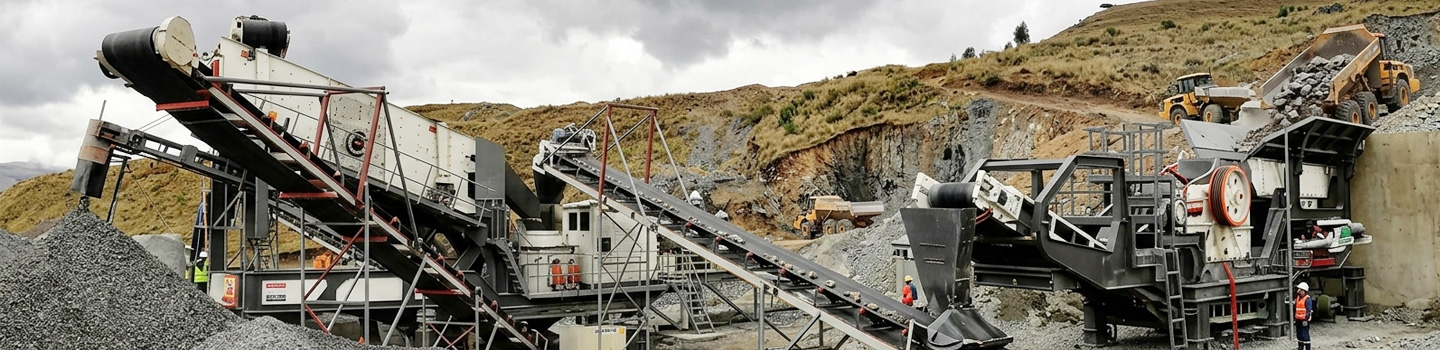
Mobile crushing technology is reshaping the global aggregate and mining industry. What was once a fixed, infrastructure-heavy process centered around permanent crushing plants is increasingly becoming a flexible, mobile, and highly efficient production model. This shift is more than a technical upgrade. It represents a structural change in how stone, mineral, and recycled material are processed, transported, and monetized across construction and mining markets.
A new logic for aggregate production
Traditional stone crushing systems have long depended on permanent installations with substantial civil works, reinforced foundations, and fixed material-handling routes. These plants often require significant upfront capital before a single ton of aggregate can be produced. They also lock operators into one location, even when quarry faces move, project sites change, or material sources are distributed across a wide area.
Mobile crushers alter that logic. Instead of building around the material, operators can now bring the crushing plant to the material itself. This simple change has far-reaching economic consequences. It reduces site-preparation costs, shortens project lead times, and enables faster responses to changing production demands.
Lower capital burden, faster deployment
One of the most important advantages of mobile crushing stations is the elimination of costly civil engineering work. Conventional fixed plants typically require excavation, foundation pouring, structural supports, and long installation schedules. These requirements increase capital expenditure and delay commissioning.
Mobile units are designed for rapid deployment. They can be transported to site, assembled quickly, and integrated into the production flow with minimal ground preparation. For quarry operators, contractors, and mining companies, this creates a more scalable investment model. Capital can be allocated to production assets rather than permanent infrastructure, improving financial flexibility and reducing project risk.
This modular approach is especially valuable in markets where demand fluctuates or where project timelines are short. Instead of committing to a permanent plant with a long payback horizon, operators can deploy mobile units for specific contracts, specific pits, or specific phases of a quarry life cycle.
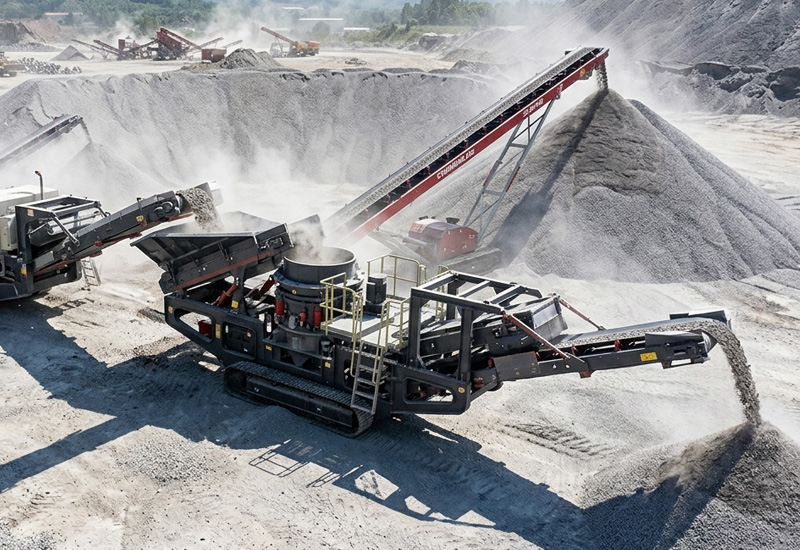
Crushing at the quarry face changes production economics
The most transformative advantage of mobile crushing is the ability to process material directly at or near the quarry face. In conventional operations, blasted rock often must be hauled long distances to a central processing plant and then moved again through multiple stages of screening, stockpiling, and loading. Each movement adds cost, fuel consumption, equipment wear, and handling losses.
By moving the crusher closer to the source, mobile systems compress the material flow into a shorter and more efficient chain. Haul trucks travel less. Conveyors and loaders work more efficiently. Internal logistics become simpler. The result is a direct reduction in operating expenditure.
This matters because haulage is one of the largest cost centers in aggregate and mining operations. Even modest reductions in in-pit transport distances can deliver meaningful savings over time. Mobile crushers therefore do not merely change where crushing happens; they change the economics of the entire production circuit.
A better fit for dynamic quarrying and mining operations
Quarries are rarely static. As faces advance and pit geometry changes, fixed infrastructure can become less efficient or even obsolete. Mobile crushing stations fit naturally into these dynamic environments. They can be relocated as the operation evolves, maintaining proximity to the material and preserving production efficiency.
This mobility also supports phased mine planning. Operators can develop deposits incrementally, position mobile equipment where it is most productive, and avoid overbuilding infrastructure too early in the project life cycle. In effect, mobile crushing turns capital investment into a more adaptive tool that follows resource extraction rather than constraining it.
For mining operations handling variable ore bodies or satellite deposits, mobile equipment can also support selective processing strategies. Material can be crushed and screened close to the extraction point, enabling more precise handling of different grades and reducing unnecessary movement of waste or low-value rock.
Urban infrastructure and recycling demand modular solutions
The rise of urban infrastructure renewal and construction waste recycling has further accelerated the adoption of mobile crushers. City projects often face severe space constraints, tight schedules, noise limitations, and the need to process material on or near site. Large permanent plants are often impractical in these environments.
Mobile stations solve this problem by offering modular, temporary processing capacity. They can be deployed for road reconstruction, demolition waste recycling, bridge replacement, and other urban projects where material must be processed locally. Instead of transporting rubble to distant facilities, contractors can crush and reuse it onsite or nearby, reducing traffic congestion, truck emissions, and disposal costs.
This capability is especially important in the circular economy. Recycled concrete and asphalt can be processed into usable aggregate with mobile equipment, helping projects recover value from demolition materials while reducing dependence on virgin quarry output. In this sense, mobile crushers are not only production tools; they are enablers of resource efficiency.
A paradigm shift for the industry
The significance of mobile crushers lies in how they reconfigure the value chain. Instead of investing heavily in fixed infrastructure and moving material across long internal distances, producers can create a distributed, modular, and adaptable crushing system that follows the resource and the project.
That shift is changing how aggregate producers, quarry owners, miners, and recyclers think about production. It reduces the barrier to entry for smaller operators, improves economics for established producers, and opens new possibilities in construction and recycling markets. As infrastructure demand expands and material handling pressures increase, mobile crushing technology is becoming a core driver of industry modernization.
Mobile crushers are therefore more than equipment. They are a catalyst for a new production model built on flexibility, efficiency, and proximity to the source. In the global aggregate and mining industry, that model is increasingly defining the future of stone crushing development.