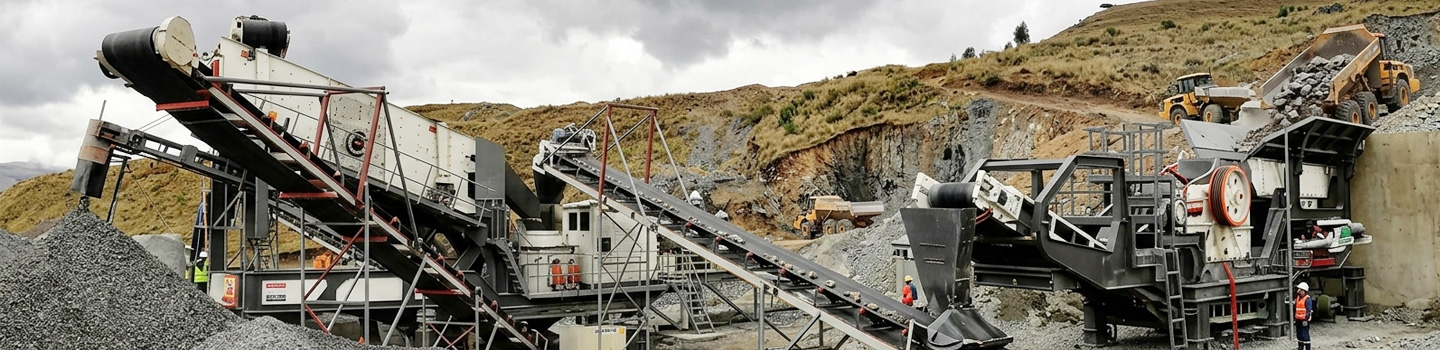
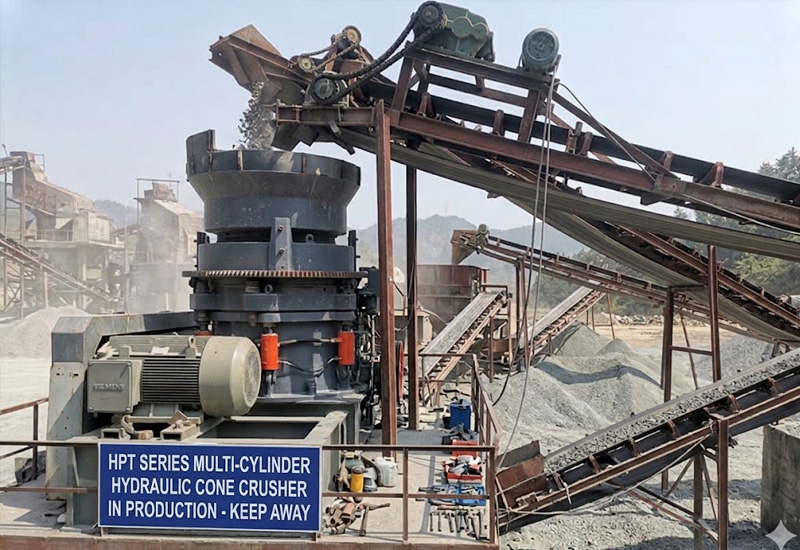
Producing high-specification crushed stone from granite is fundamentally a problem of controlled comminution. Granite is hard, abrasive and often characterized by high compressive strength, making particle-size reduction demanding on both crushing equipment and the overall plant flowsheet. Cone crushers play a critical role because they can convert pre-crushed granite into tightly controlled, well-shaped aggregate while maintaining throughput and managing wear. In modern secondary and tertiary circuits, multi-cylinder hydraulic cone crushers such as the HPT series are particularly suited to balancing reduction ratio, product gradation and particle shape.
Balancing the Multi-Stage Crushing Circuit
A successful granite operation does not depend on a single crusher operating at maximum capacity. Instead, performance comes from balancing the entire multi-stage circuit. Primary crushing establishes a suitable feed size for secondary reduction, while secondary and tertiary cone crushing progressively reduces the material toward the final specification.
The objective is to distribute the crushing ratio between stages rather than forcing one machine to perform excessive reduction. If the secondary crusher receives oversized or poorly prepared feed, its capacity can fall and circulating loads can increase. Conversely, insufficient reduction in the secondary stage can overload tertiary equipment and screening systems.
Closed-circuit operation provides an important control mechanism. After crushing, screens separate correctly sized particles from oversize material, which is returned to the cone crusher for further reduction. This recirculation allows the circuit to continuously correct the product while preventing excessive production of material that is already within specification.
For hard granite, maintaining an appropriate circulating load is especially important. Excessive recirculation consumes energy and reduces effective plant capacity, while inadequate recirculation can compromise final particle-size distribution. Properly matched crushers and screens therefore allow secondary and tertiary stages to operate closer to their optimum operating ranges.
CSS Regulation and Reduction Control
The closed-side setting (CSS) is one of the most influential parameters in cone-crushing performance. CSS determines the minimum distance between the mantle and concave during the crushing cycle and consequently affects product size, throughput and the amount of fine material generated.
Reducing CSS generally increases the degree of size reduction and shifts the product toward smaller particles. However, simply tightening the setting is not always the best way to achieve a high-quality aggregate. Excessive compression can increase power demand, accelerate wear and generate unnecessary fines.
Multi-cylinder hydraulic cone crushers provide precise CSS adjustment and hydraulic protection, making it easier to adapt the crushing chamber to variations in granite feed characteristics. Consistent CSS also supports stable downstream screening because the screen receives a more predictable size distribution.
In a well-designed closed circuit, CSS should therefore be regulated together with screen aperture, feed rate and crusher cavity selection. These variables form an integrated control system: the crusher determines how material is broken, while the screen determines which particles remain in the circuit and which return for additional crushing.
Inter-Particle Crushing and Particle Shape
Particle shape is just as important as size when producing high-specification crushed stone. Conventional compression can produce elongated or flaky particles if the crushing conditions favor fracture along preferential planes. Such particles can negatively affect aggregate packing, asphalt performance and concrete properties.
Modern hydraulic cone crushers address this challenge through inter-particle comminution. Instead of relying solely on compression between the mantle and concave, particles are compressed against one another within a tightly packed crushing chamber. This rock-on-rock interaction promotes fracture through weaker internal zones and produces more equidimensional particles.
Optimized cavity geometry is central to this process. The shape and profile of the crushing chamber determine how granite moves through the crusher, how long it remains under compression and how effectively particles interact. A properly selected cavity maintains an appropriate crushing environment across the entire chamber rather than concentrating reduction in a narrow zone.
The result can be a more cubical product with fewer elongated particles and a lower flakiness ratio. For aggregate producers, this is particularly valuable where specifications demand controlled shape characteristics in addition to strict particle-size limits.
Integrating Screening with Secondary and Tertiary Stages
The cone crusher should ultimately be viewed as part of a coordinated crushing-and-screening system. In a tight closed circuit, screens remove finished material as soon as it reaches the required size, while oversize is returned to the crusher. This prevents already-compliant particles from undergoing unnecessary additional crushing.
Such integration can improve both energy efficiency and shape control. Removing correctly sized material reduces the probability of over-crushing and excessive fines generation. At the same time, recirculated oversize receives additional inter-particle compression, increasing the opportunity for irregular particles to be reshaped into more cubical forms.
For tertiary applications, the arrangement can be tuned to produce specific manufactured-sand or fine-aggregate fractions, while maintaining adequate capacity in the secondary stage. The overall flowsheet can consequently achieve a better balance between throughput, reduction ratio, screening efficiency and final aggregate quality.
Optimizing the Granite-to-Aggregate Process
Converting abrasive granite into high-specification crushed stone is therefore less about maximizing individual crusher output than about controlling the entire comminution circuit. Multi-cylinder hydraulic cone crushers combine accurate CSS regulation, optimized cavity geometry and inter-particle crushing to provide a controlled reduction environment.
When paired with appropriately sized screens and well-balanced secondary and tertiary stages, this approach helps stabilize particle-size distribution while improving aggregate shape. The resulting cubical profile, reduced flakiness and controlled fines production can enable producers to meet demanding specifications more consistently.
For granite processing plants, the most effective flowsheet is consequently one in which crusher settings, cavity design, feed distribution and closed-circuit screening operate as a coordinated system. The cone crusher becomes not merely a size-reduction machine, but the central control point for transforming hard, abrasive rock into commercially valuable, specification-grade aggregate.