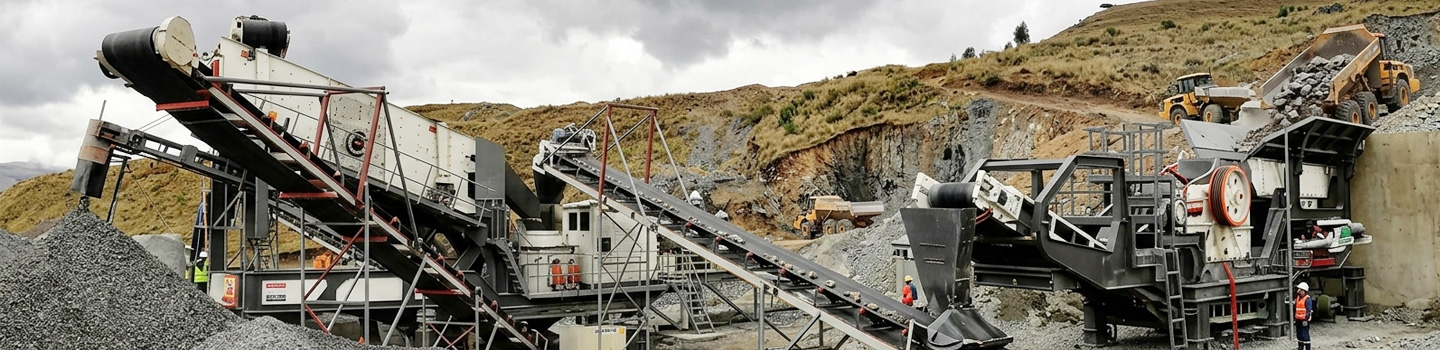
Modern advanced crushing technology represents a shift away from uncontrolled impact and concentrated mechanical stress toward precision force management. The goal is no longer simply to generate enough crushing force, but to apply that force in the most efficient way possible. Through optimized motion profiles, improved stroke-to-speed relationships, carefully engineered nip angles, and enhanced inter-particle crushing mechanisms, advanced systems achieve greater size reduction with lower energy consumption and longer equipment life.
The Evolution of Hard Rock Comminution
Comminution—the process of reducing mined rock into smaller fragments—is one of the most energy-intensive stages in mineral processing. Conventional crushing methods typically depend on direct compression between large mechanical surfaces. A rock particle is trapped between a moving and stationary surface, and increasing pressure eventually exceeds the rock’s tensile strength, causing fracture.
However, hard and abrasive ores introduce several problems:
- High localized stresses: Crushing forces concentrate at limited contact points, creating extreme pressure zones.
- Excessive wear: Crusher liners, mantles, and other contact surfaces experience aggressive abrasion.
- Energy losses: A significant portion of input energy is converted into heat, deformation, vibration, and mechanical stress rather than useful fragmentation.
- Structural fatigue: Repeated shock loading accelerates cracking and failure in major components.
The limitation of traditional crushing is not a lack of force—it is inefficient force application. Advanced crushing technologies focus on controlling how energy enters the rock mass.
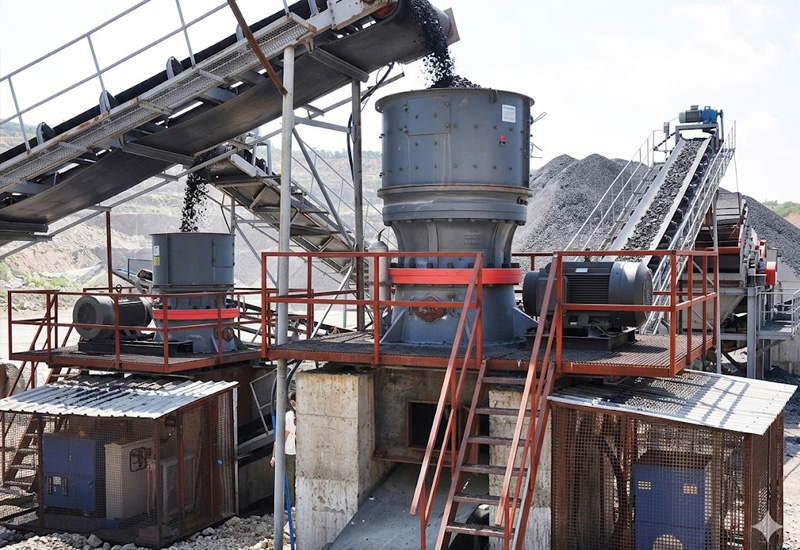
Understanding the Mechanics of Rock Fracture
Rock does not fail simply because a force is applied. It fractures when stresses exceed its internal strength and create crack propagation. Different types of loading produce different fracture behaviors:
- Compression: Creates crushing zones and internal fractures.
- Tension: Generates cracks more efficiently because most rocks have much lower tensile strength than compressive strength.
- Shear: Produces sliding fractures and contributes to particle liberation.
Conventional crushers often rely heavily on compressive loading. Advanced designs attempt to introduce more efficient fracture pathways by controlling compression speed, contact geometry, and particle interaction.
The objective is to create a controlled fracture environment where energy is directed into breaking mineral bonds rather than deforming the machine or generating unnecessary fines.
Moving Beyond Brute Force: Optimized Force Distribution
The central principle behind advanced hard rock crushing is optimized force distribution. Instead of applying maximum force at isolated contact points, modern systems aim to spread mechanical energy through a larger volume of material.
This approach improves efficiency in several ways:
1. Distributed Stress Fields
Advanced crushing chambers are designed to maintain consistent pressure throughout the crushing zone. Rather than allowing a few large particles to absorb extreme loads while others escape relatively untouched, optimized chambers encourage more uniform stress distribution.
The result is:
- More consistent particle breakage
- Reduced peak loading
- Lower mechanical shock
- Improved liner utilization
2. Controlled Energy Transfer
The relationship between applied force and rock response is critical. If force is applied too aggressively, the machine absorbs unnecessary reaction forces. If applied too slowly, energy may be wasted through deformation rather than fracture.
Advanced crushers balance:
- Applied force magnitude
- Compression duration
- Movement frequency
- Material flow behavior
This creates a more efficient fracture cycle.
Inter-Particle Crushing: Using the Rock Mass as the Crushing Tool
One of the most important developments in modern comminution is the increased use of inter-particle crushing.
Traditional crushing relies primarily on rock-to-metal contact:
Rock → Crushing surface → Fracture
Advanced crushing systems increasingly promote:
Rock → Rock interaction → Distributed fracture
When multiple particles are compressed together, force is transferred through the particle bed. Larger particles are fractured not only by direct machine contact but also by surrounding particles pushing against them.
This creates several advantages:
- Reduced direct impact on liners
- More efficient energy utilization
- Improved particle shape
- Increased mineral liberation
Inter-particle crushing is especially valuable for highly abrasive ores because it reduces dependence on metal-to-rock contact, which is the primary driver of wear.
The Importance of Stroke-to-Speed Ratio
A key mechanical parameter in advanced crushing design is the relationship between stroke and operating speed.
Stroke
Stroke refers to the distance a crushing element moves during a compression cycle. A longer stroke generally increases the volume of material affected during each cycle and allows deeper penetration into the rock bed.
Speed
Speed determines how frequently crushing cycles occur. Increasing speed can raise throughput but may reduce the time available for efficient fracture if not properly matched with stroke.
The optimal stroke-to-speed ratio creates a balance:
- Enough movement to fully compress and fracture particles
- Enough cycle frequency to maintain productivity
- Controlled loading to prevent excessive shock forces
An improperly matched system can create inefficiencies:
Too much stroke with insufficient speed:
- Lower throughput
- Increased mechanical stress
- Longer compression cycles
Too much speed with insufficient stroke:
- Incomplete fracture
- Higher recirculation loads
- Increased energy consumption
Advanced crushing equipment uses optimized stroke-to-speed relationships to maximize the amount of useful fracture energy delivered per unit of power.
Optimized Nip Angles and Material Capture
The nip angle—the angle between crushing surfaces where material enters the crushing chamber—is another critical factor in hard rock processing.
A properly designed nip angle determines whether particles are effectively captured and compressed or whether they slip through the crushing zone.
If the nip angle is too large:
- Material may slide rather than fracture
- Energy is wasted
- Throughput decreases
If the nip angle is too small:
- Crushing capacity may be reduced
- The crushing chamber may become underutilized
Advanced designs optimize the nip angle according to:
- Rock hardness
- Feed size distribution
- Particle shape
- Crusher geometry
- Material friction characteristics
The objective is stable particle engagement, allowing forces to penetrate the rock efficiently while maintaining smooth material flow.
Reducing Energy Consumption Through Smarter Crushing
The energy challenge in mining is not simply about producing more force—it is about improving energy efficiency.
Advanced crushing technologies reduce energy consumption by:
Improving Fracture Efficiency
By encouraging crack propagation through optimized loading conditions, more input energy becomes useful breakage energy.
Reducing Over-Crushing
Poorly controlled crushing can generate excessive fines that require additional downstream processing. Optimized fracture produces a more desirable size distribution.
Minimizing Recirculation
Better crushing performance reduces the amount of material that must pass repeatedly through the circuit.
Lowering Mechanical Losses
Reduced vibration, shock loading, and friction decrease wasted mechanical energy.
Managing Structural Fatigue in Extreme Applications
Hard rock mining places crushing equipment under thousands of repeated loading cycles. Over time, even small stress concentrations can lead to fatigue failure.
Advanced crushing designs address this through:
- Smoother force application
- Reduced peak loads
- Balanced mechanical motion
- Improved load paths
- More consistent chamber pressure
Rather than allowing sudden spikes of force, optimized systems maintain controlled mechanical stress. This extends component life and reduces downtime in high-abrasion environments.
The Future of Hard Rock Comminution
Advanced crushing technology represents a fundamental change in how hard rock is processed. Instead of relying on overwhelming mechanical force, modern systems focus on precision energy delivery, optimized motion, and controlled fracture mechanics.
The transition from brute-force crushing to advanced comminution is built on several key principles:
- Efficient force distribution instead of concentrated impact
- Inter-particle crushing instead of excessive rock-to-metal contact
- Optimized stroke-to-speed ratios for maximum fracture efficiency
- Proper nip angles for stable material capture
- Reduced energy waste and structural fatigue
For high-hardness, highly abrasive ores, the future of crushing is not about building stronger machines to withstand greater punishment. It is about designing smarter machines that require less punishment in the first place—turning the physics of the rock itself into an advantage.