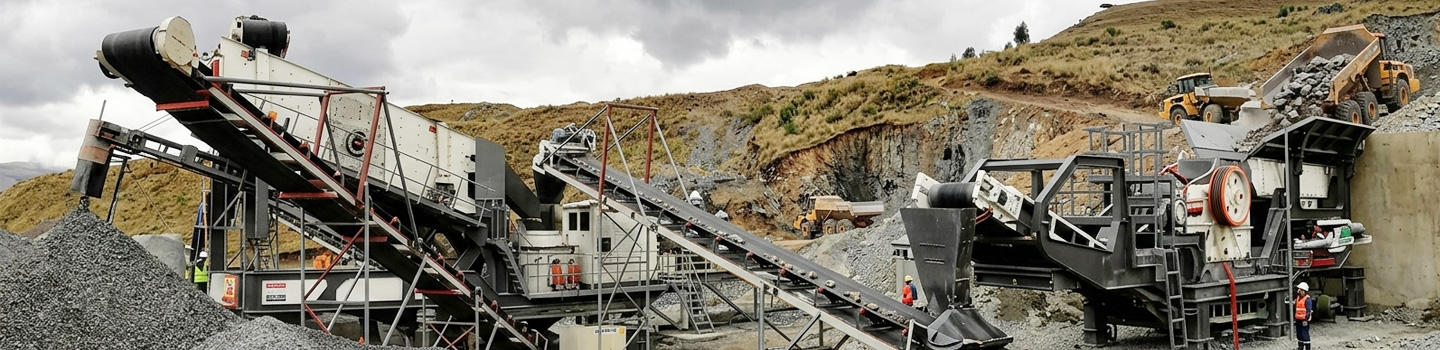
Designing an industrial crushing plant capable of consistently producing 250 to 300 cubic meters per hour requires more than selecting a crusher with sufficient nominal capacity. It involves engineering an integrated crushing circuit in which feeding, primary reduction, secondary crushing, screening, and material recirculation operate in synchronization. Every component must be sized to accommodate variations in material hardness, bulk density, feed size, moisture content, and required product gradation.
A properly balanced circuit combines vibrating grizzly feeders, C6X Series primary jaw crushers, HST/HPT Series hydraulic cone crushers or CI5X Series impact crushers, and S5X Series vibrating screens. The objective is to maintain continuous throughput while minimizing bottlenecks, unnecessary recirculation, and equipment downtime.
1. Converting Volumetric Capacity into Tonnage
One of the first considerations when specifying a crusher with a capacity of 250 to 300 cubic meters per hour is understanding the relationship between volumetric throughput and gravimetric production.
The conversion depends on the bulk density of the processed material:
Mass throughput (tph) = Volumetric throughput (m³/h) × Bulk density (t/m³)
For typical crushed rock with bulk densities ranging from 1.4 to 1.7 tonnes per cubic meter, the required tonnage varies considerably.
| Volumetric capacity | At 1.4 t/m³ | At 1.5 t/m³ | At 1.7 t/m³ |
|---|---|---|---|
| 250 m³/h | 350 tph | 375 tph | 425 tph |
| 275 m³/h | 385 tph | 412.5 tph | 467.5 tph |
| 300 m³/h | 420 tph | 450 tph | 510 tph |
Consequently, the crushing circuit should generally accommodate approximately 350–510 tonnes per hour, depending on the material and operating target.
These calculations assume that volumetric capacity refers to loose bulk volume. Engineers must distinguish between loose feed volume, solid-rock volume, and finished-product volume when preparing equipment specifications.
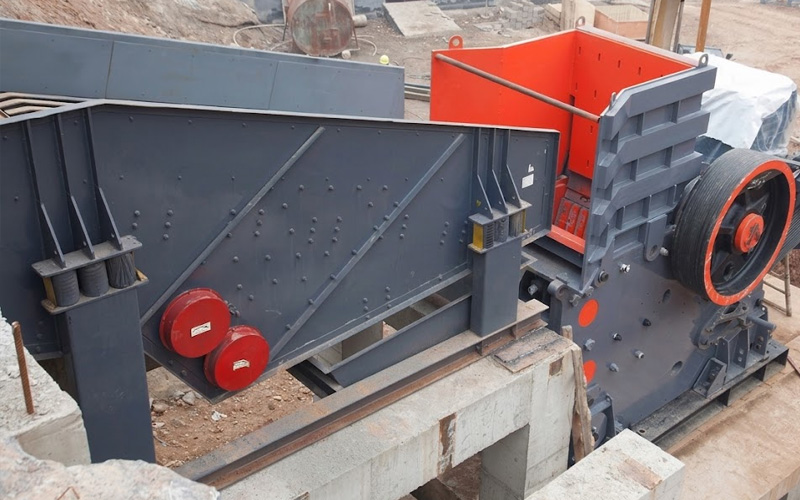
2. Primary Crushing: Feeding and C6X Jaw Crushers
The primary crushing stage establishes the foundation for overall plant performance. A vibrating grizzly feeder should be installed ahead of the primary jaw crusher to regulate material delivery and remove undersized particles before crushing.
This arrangement offers several advantages:
- Controls feed distribution and prevents crusher overloading.
- Separates fines, reducing unnecessary crushing energy.
- Absorbs fluctuations in material delivery.
- Protects downstream equipment from inconsistent feed conditions.
The C6X Series jaw crusher is a suitable primary crushing option for demanding industrial applications. Its robust structure, optimized crushing chamber, and hydraulic adjustment capabilities support the processing of large feed materials.
For a 250–300 m³/h circuit, the selected jaw crusher must provide sufficient capacity under actual operating conditions rather than relying exclusively on maximum catalog ratings. Feed opening dimensions, CSS, rock hardness, and the percentage of fines all influence achievable output.
3. Secondary Crushing: HST/HPT Cones or CI5X Impactors
The secondary stage determines much of the final product quality and circuit efficiency. Two configurations are particularly relevant.
Hydraulic cone crushing: HST/HPT Series
HST and HPT hydraulic cone crushers are appropriate for hard and abrasive materials, including granite, basalt, and other competent rocks. Their advantages include:
- Consistent particle reduction.
- Adjustable closed-side settings.
- High crushing efficiency.
- Improved control over product gradation.
A cone crusher is generally preferred when the objective is producing durable, well-shaped aggregates from abrasive materials while maintaining continuous industrial throughput.
Impact crushing: CI5X Series
For medium-hard materials and applications requiring improved particle shape, CI5X impact crushers offer an alternative. Their impact-based reduction mechanism can produce cubical aggregates with favorable particle characteristics.
However, wear costs can increase significantly when processing highly abrasive rock. Material abrasiveness and operating economics should therefore determine the selection.
4. Screening and Closed-Circuit Material Management
The S5X Series vibrating screen provides the classification function required to maintain consistent product specifications. Correct screen sizing and configuration are essential because insufficient screening capacity can restrict the entire crushing circuit.
A closed-circuit arrangement returns oversize material to the secondary crusher while allowing correctly sized aggregates to proceed to stockpiles.
Engineers must coordinate the crusher’s closed-side setting (CSS) with screen aperture dimensions. An excessively tight CSS can increase fines generation and recirculating load, while an overly wide setting may produce excessive oversize material.
The objective is to establish a balanced relationship between crusher reduction ratios, screen efficiency, and final product requirements.
5. Surge Hopper Buffering and Recirculating Load Control
Continuous production requires effective management of fluctuations between processing stages. A properly sized surge hopper between primary and secondary crushing provides temporary storage, preventing short interruptions in primary feed from immediately affecting secondary production.
Variable-speed feeders can regulate discharge from the hopper according to downstream crusher demand.
Recirculating load must also be monitored carefully. Excessive oversize returns increase secondary crusher utilization, consume additional energy, and reduce net plant capacity.
Useful control measures include:
- Monitoring screen oversize and undersize flows.
- Adjusting secondary crusher CSS.
- Regulating feeder discharge rates.
- Tracking motor power and crusher utilization.
- Monitoring conveyor loading and transfer points.
These measures help maintain stable production without allowing one processing stage to become overloaded.
6. Eliminating Bottlenecks to Sustain 250–300 m³/h
Achieving the target capacity requires designing every component around the same production objective. A crusher rated above 300 m³/h cannot guarantee plant output if conveyors, screens, feeders, or transfer points have lower capacities.
The engineering design should therefore consider peak material loading, moisture-related screening losses, maintenance availability, and realistic operating utilization.
A practical approach is to provide sufficient design margin above the required average production rate, with equipment capacities verified against the actual material characteristics.
Automated monitoring and coordinated control systems can further improve performance by adjusting feeder speeds, crusher settings, and material distribution in response to changing operating conditions.
Conclusion
A crusher with a capacity of 250 to 300 cubic meters per hour should be engineered as a complete, balanced crushing circuit rather than an isolated machine. Combining vibrating grizzly feeders, C6X primary jaw crushers, HST/HPT cone crushers or CI5X impactors, and S5X vibrating screens creates a flexible foundation for industrial aggregate production.
By accurately converting volumetric throughput into tonnage, synchronizing CSS settings, incorporating surge hopper buffering, controlling recirculating loads, and eliminating downstream bottlenecks, operators can achieve reliable production performance. Ultimately, successful plant design depends on matching every processing stage to the required output, material characteristics, and final aggregate specifications.