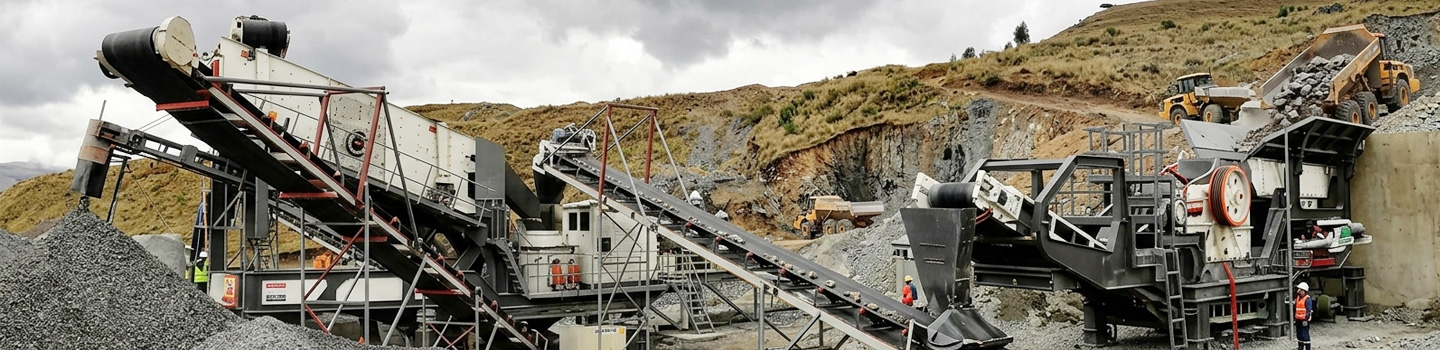
In high-capacity aggregate production, the integration of an aggregate cone crusher and screening plant within a closed-circuit system represents the pinnacle of process efficiency. Achieving optimum output requires precise calibration of material flow mass balance, mechanical synchronization, and strict control of the circulating load ratio. When these engineering variables are properly aligned, the system maximizes throughput, maintains ideal cubical product geometry, and prevents catastrophic circuit bottlenecks such as surge bin choking.
Closed-Circuit Synchronization and Mass Balance Mechanics
The primary objective of a closed-circuit crushing and screening module is to reduce raw material to a specific size distribution while continuously recirculating oversized material. This loop relies on a delicate balance between the high-performance hydraulic cone crusher and a heavy-duty industrial screening plant.
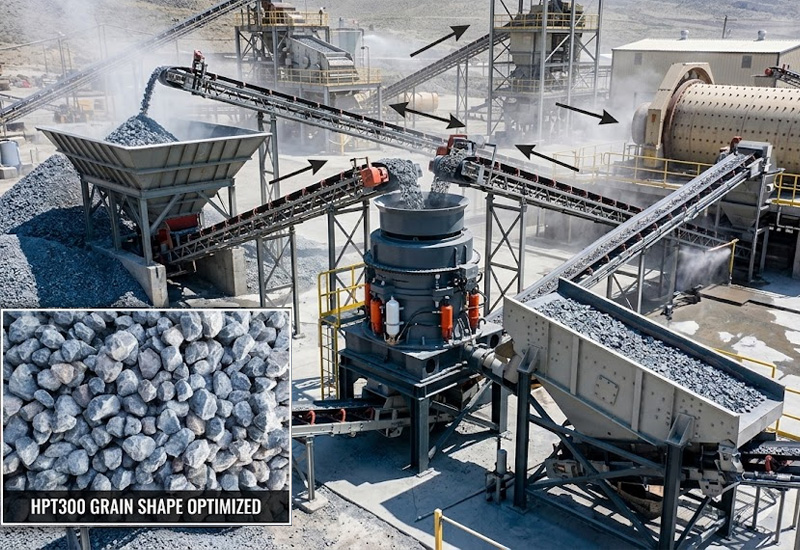
In this configuration, the laminated output from the cone crusher is direct-fed via conveyor to a multi-deck vibrating screen. The material flow splits by size classification: acceptable product passes through the screen decks to final product stockpiles, while particles exceeding the top-deck mesh aperture are intercepted and returned via a reject conveyor back into the crusher’s chamber.
Screen Mesh Configurations and Graduation Curves
The heavy-duty industrial screening plant dictates the final product quality by enforcing strict physical boundaries on particle size. The selection of screen media and mesh configuration directly governs the final aggregate graduation curves. Multi-deck vibrating screens use progressive aperture sizing to slice the laminated material profile systematically:
- Top Deck (Scalping): Protects lower decks by separating the coarsest fractions. Its aperture size is calculated slightly larger than the crusher’s Closed Side Setting (CSS) to isolate the oversized return loop.
- Mid Decks (Classification): Segregates mid-range commercial aggregate sizes (e.g., 10–20mm and 5–10mm). Mesh geometries must account for material moisture and near-size particle crowding to prevent blinding.
- Bottom Deck (Fines Control): Extracts the final sand or micro-fraction (0–5mm), directly shaping the lower tail of the graduation curve.
Stratification is critical: high-frequency, circular, or elliptical motion paths throw the material bed upward, allowing smaller particles to migrate downward through the void spaces toward the screen cloth, ensuring high screening efficiency ($E$).
Managing Circulating Load Ratios and Control Strategies
To prevent surge bin choking and maximize plant efficiency, automated control strategies must manage the circulating load dynamically. When processing tough rock types like basalt or granite, the inter-particle compression (laminated crushing) inside the cone crusher generates a dense product stream, but also creates variations in the return loop volume depending on moisture and liner wear.
| System Component | Operational Risk | Control Mechanism / Strategy |
|---|---|---|
| Surge Bins | Choking, Material Bridging | Ultrasonic level sensors triggering variable-speed belt feeders to modulate primary inputs. |
| Cone Crusher Cavity | Ring Bounce, Overloading | Real-time PLC monitoring of hydraulic pressure and motor amperage to adjust the Closed Side Setting (CSS). |
| Vibrating Screen Decks | Material Carryover, Blinding | Frequency inverter speed tuning to optimize material bed depth (typically maintained at 2-3 times the aperture size). |
Technical Parameter Verification and Equipment Modules
To ensure structural sizing compatibility and circuit synchronization, the physical boundaries of the equipment must be strictly mapped. Utilizing precise parameters from the Liming Global Product Database, high-efficiency crushing-screening modules are engineered around flagship secondary units coupled with high-capacity screening plants.
Module Configuration A: The HPT300 High-Efficiency Hydraulic Circuit
The HPT300 Hydraulic Cone Crusher is deployed as the core secondary reduction engine within this module, optimized for maximum particle stratification and cubical shape formatting.
- Crusher Model: HPT300 Hydraulic Cone Crusher
- Maximum Feed Boundary: 220 mm
- Capacity Range: 110 – 440 t/h
- Power Rating: 220 kW
- Matched Screening Unit: SKX1536 Multi-Deck Vibrating Screen (Configured for With Return Material Screening within the NK300H mobile framework, bringing total module power consumption to 323.5 kW).
Module Configuration B: The HST250 Single-Cylinder Heavy-Duty Circuit
For applications requiring rapid adjustment of the CSS via an automated control system to handle erratic feed distributions, the single-cylinder platform provides optimized hydraulic stability.
- Crusher Model: HST250 Single-Cylinder Cone Crusher
- Power Rating: 250 kW
- System Integration: Typically linked with high-capacity horizontal or inclined screens to maintain a high-tonnage circulating loop for large-scale infrastructure projects.
A surge bin equipped with continuous ultrasonic level sensors sits directly between the secondary HPT300 cone crusher and the screen module. The control loop modulates the frequency of the variable-speed vibrating feeder feeding the crusher based on real-time bin levels. If the level in the surge bin exceeds 80% capacity—indicating that screen throughput is falling behind crusher output—the upstream feed is automatically throttled. This prevents overflow, manages the circuit’s material volume, and protects the structural frame of the screening plant from excessive weight stress.