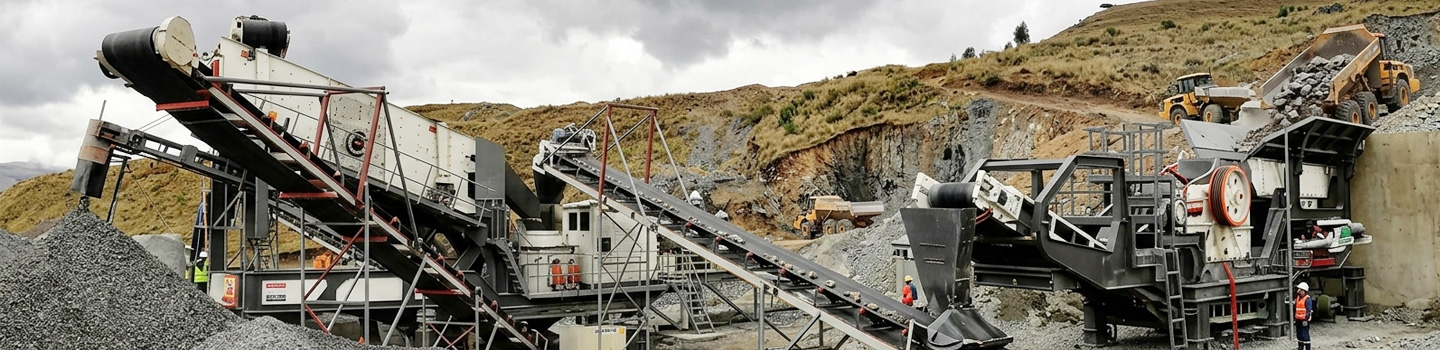
In aggregate production and mining, the cone crusher is the workhorse of the reduction circuit. Yet, in many plants, it operates well below its true volumetric and mechanical potential. While manufacturers provide theoretical capacity charts, real-world throughput is won or lost on the shifting dynamics of the crushing chamber.
To transition from baseline operation to maximum throughfeed, operators must move past theoretical abstractions and actively manipulate the primary mechanical levers of the machine. True optimization requires balancing three critical variables: the Closed-Side Setting (CSS) relative to feed distribution, choke-feeding dynamics, and eccentric throw adjustment.
Balancing CSS and Feed Distribution: Eliminating the “Squeeze” Bottleneck
The Closed-Side Setting (CSS) is the narrowest distance between the mantle and the bowl liner at the bottom of the crushing chamber. While it directly dictates product granulometry, it is also the primary valve controlling volumetric flow.
[Feed Material] ➔ [Incorrect Segregation] ➔ Poor Cavity Utilization ➔ Reduced Throughput
[Feed Material] ➔ [Optimized 360° Blend]  ➔ Uniform Cavity Flow   ➔ Maximum Throughput
Optimizing throughput requires treating the CSS not as a static setpoint, but as a dynamic variable paired with feed distribution.
The Perils of Segregated Feed
When feed material is poorly distributed—for instance, large rocks falling to one side of the cavity while fines settle on the other—the crusher suffers from uneven loading. The side receiving coarse material experiences localized high pressure, causing structural stress, while the side receiving fines passes material with minimal reduction, leading to a poor product shape and wasted cavity space.
The Field Methodology
-
Implement 360° Uniform Distribution: Utilize a distribution plate or a bi-flow feed box directly above the crusher. The feed must enter the crushing chamber vertically and be distributed evenly around the entire circumference of the mantle.
-
Match CSS to Top Size Feed: Ensure the CSS is tightly calibrated to the incoming feed’s F80 (the size at which 80% of the feed passes). If the CSS is too tight relative to an oversized feed, the chamber suffers from “bridging,” where large rocks block the upper cavity, starving the lower chamber and crashing throughput.
-
Dynamic CSS Tracking: Monitor liner wear daily. As liners thin, the physical CSS widens even if the automation system claims otherwise. Calibrate the CSS using lead tire tests or digital calibration tools every 24–48 operating hours to maintain the optimum setting.
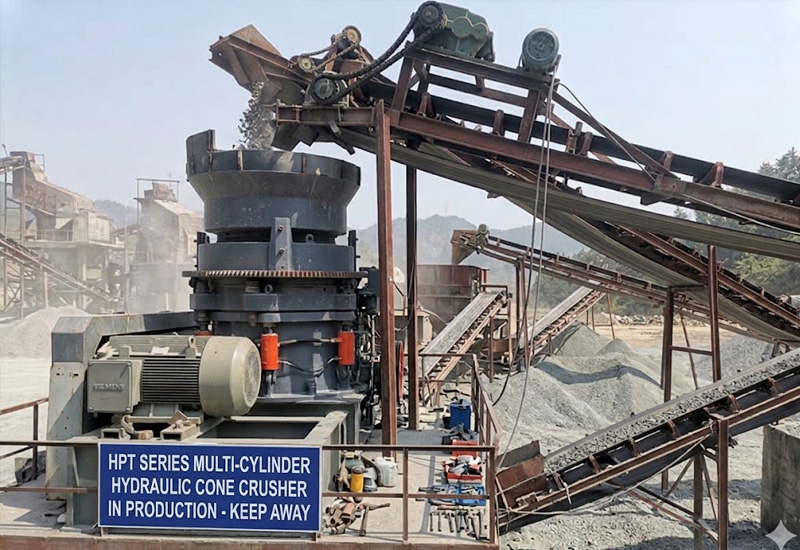
Optimizing Choke-Feeding: Leveraging Inter-Particle Crushing
Operating a cone crusher with a low cavity level—often referred to as “trickle feeding”—is highly inefficient. It relies purely on single-particle crushing (steel-on-rock), which accelerates liner wear, produces a flaky product, and severely limits throughput.
To maximize throughfeed, the crusher must be operated under choke-feed conditions.
The Power of Inter-Particle Crushing
Choke-feeding occurs when the head of the crusher is completely submerged in material, keeping the entire crushing cavity full. This level of material creates a high-pressure zone where rocks are forced to crush against one another (inter-particle crushing) rather than just against the steel liners.
| Feeding Method | Primary Crushing Mechanism | Liner Wear Rate | Throughput Efficiency | Product Shape |
| Trickle Feed | Single-Particle (Steel-on-Rock) | High / Localized | Low | Flaky / Elongated |
| Choke Feed | Inter-Particle (Rock-on-Rock) | Even / Distributed | Maximum | Cubical / Premium |
The Field Methodology
-
Maintain the Optimum Choke Level: The material level should be kept at a minimum of 300 mm above the top of the mantle, or level with the top of the spider cap (depending on the crusher design).
-
Interlock the Surge Bin and Feeders: Tie the speed of your variable speed drive (VSD) feed conveyors or vibrating feeders directly to the crusher’s ultrasonic level sensor. If the cavity level drops, the feeder speed must automatically increase to maintain the choke point.
-
Pre-Screen Fines: Inter-particle crushing relies on void spaces between rocks. If the feed contains excessive fines (material already smaller than the CSS), the cavity becomes packed, resulting in “pancake” compaction. Pre-screen the feed to eliminate sub-size material before it enters the crusher.
Adjusting Eccentric Throws: Maximizing Volumetric Capacity
The eccentric throw (the stroke of the crushing head) determines how far the mantle moves during each rotation. It dictates the volume of the “crushing pocket” formed between the mantle and bowl liner with every cycle. Adjusting the throw is the most potent, yet underutilized, lever for maximizing volumetric capacity.
Balancing Capacity, Amperage, and Ring Bounce
A longer eccentric throw increases the volume of material processed per stroke, directly driving up throughput. However, a longer throw also increases the reduction ratio and mechanical forces, which can push the machine toward two operational ceilings:
-
Motor Overload: Exceeding the rated amperage (A) or power draw (kW) of the motor.
-
Ring Bounce: Occurs when the crushing forces exceed the hold-down pressure of the tramp release cylinders, causing the upper frame to lift. This damages the seat surfaces and alters the CSS.
Longer Eccentric Throw ➔ Larger Crushing Pocket ➔ Higher Throughput
                                                       ⬇
                                        (Must monitor Amperage & Ring Bounce)
The Field Methodology
-
Assess Material Hardness: If you are crushing soft or highly friable rock, select the maximum available eccentric throw. The material will fracture easily, allowing the crusher to utilize the full volumetric stroke without drawing excessive power.
-
Step Down for High-Compressive Strength Rock: If you are crushing hard, abrasive ore (e.g., granite, quartzite) and experiencing ring bounce or motor spikes, reduce the eccentric throw step-by-step. This lowers the instantaneous crushing force, stabilizes the ring, and allows you to maintain a tighter, more consistent CSS—ultimately yielding higher net throughput of the desired product size.
-
Tune Eccentric Speed (RPM): Throw and speed act in tandem. If the throw is maximized, ensure the countershaft speed is optimized (typically between 700-950 RPM depending on model specifications) to allow material sufficient time to fall into the next crushing pocket before the mantle closes again.